This site displays a prototype of a “Web 2.0” version of the daily
Federal Register. It is not an official legal edition of the Federal
Register, and does not replace the official print version or the official
electronic version on GPO’s govinfo.gov.
The documents posted on this site are XML renditions of published Federal
Register documents. Each document posted on the site includes a link to the
corresponding official PDF file on govinfo.gov. This prototype edition of the
daily Federal Register on FederalRegister.gov will remain an unofficial
informational resource until the Administrative Committee of the Federal
Register (ACFR) issues a regulation granting it official legal status.
For complete information about, and access to, our official publications
and services, go to
About the Federal Register
on NARA's archives.gov.
The OFR/GPO partnership is committed to presenting accurate and reliable
regulatory information on FederalRegister.gov with the objective of
establishing the XML-based Federal Register as an ACFR-sanctioned
publication in the future. While every effort has been made to ensure that
the material on FederalRegister.gov is accurately displayed, consistent with
the official SGML-based PDF version on govinfo.gov, those relying on it for
legal research should verify their results against an official edition of
the Federal Register. Until the ACFR grants it official status, the XML
rendition of the daily Federal Register on FederalRegister.gov does not
provide legal notice to the public or judicial notice to the courts.
Proposed Rule
Enter a search term or FR citation e.g.
88 FR 38230 FR 78782024-13208USDA09/05/24RULE0503-AA39SORN
Choosing an item from
full text search results
will bring you to those results. Pressing enter in the search box
will also bring you to search results.
Choosing an item from
suggestions
will bring you directly to the content.
Airworthiness Directives; Model HH-1K, TH-1F, TH-1L, UH-1A, UH-1B, UH-1E, UH-1F, UH-1H, UH-1L, and UH-1P; and Southwest Florida Aviation Model SW204, SW204HP, SW205, and SW205A-1 Helicopters, Manufactured by Bell Helicopter Textron, Inc. (BHTI) for the Armed Forces of the United States
Comments must be received on or before April 28, 2003.
Table of Contents
Enhanced Content - Table of Contents
This table of contents is a navigational tool, processed from the
headings within the legal text of Federal Register documents.
This repetition of headings to form internal navigation links
has no substantive legal effect.
Document page views are updated periodically throughout the day and are
cumulative counts for this document. Counts are subject to sampling,
reprocessing and revision (up or down) throughout the day.
Page views
432
as of
11/11/2026 at 2:15 am EST
Other Formats
Enhanced Content - Other Formats
This document is also available in the following formats:
This document has been published in the Federal Register. Use the PDF linked in the document sidebar for the official electronic format.
AGENCY:
Federal Aviation Administration, DOT.
ACTION:
Notice of proposed rulemaking (NPRM).
SUMMARY:
This document proposes the supersedure of an existing airworthiness directive (AD) that applies to specified type-certificated military surplus helicopters. That AD currently requires visual and radiographic inspections of the Boom Station (BS) 194 skin joint area and the vertical fin spar caps for cracks or fretting. This action would require those same actions, but would update the type certificate holder names and add additional model helicopters to the applicability. This proposal is prompted by the need to update the current type certificate holders and to expand the applicability to additional military surplus helicopters, and expand the inspection to include corrosion and loose or working rivets. The actions specified by the proposed AD are intended to detect a crack in the skin of a tailboom assembly, tail rotor gearbox support fitting, or vertical fin spar, which could cause failure of the tailboom and loss of control of the helicopter.
DATES:
Comments must be received on or before April 28, 2003.
ADDRESSES:
Submit comments in triplicate to the Federal Aviation Administration (FAA), Office of the Regional Counsel, Southwest Region, Attention: Rules Docket No. 2002-SW-31-AD, 2601 Meacham Blvd., Room 663, Fort Worth, Texas 76137. You may also send comments electronically to the Rules Docket at the following address:
9-asw-adcomments@faa.gov.
Comments may be inspected at the Office of the Regional Counsel between 9 a.m. and 3 p.m., Monday through Friday, except Federal holidays.
Interested persons are invited to participate in the making of the proposed rule by submitting such written data, views, or arguments as they may desire. Communications should identify the Rules Docket number and be submitted in triplicate to the address specified above. All communications received on or before the closing date for comments will be considered before taking action on the proposed rule. The proposals contained in this document may be changed in light of the comments received.
Comments are specifically invited on the overall regulatory, economic, environmental, and energy aspects of the proposed rule. All comments submitted will be available, both before and after the closing date for comments, in the Rules Docket for examination by interested persons. A report summarizing each FAA-public contact concerned with the substance of this proposal will be filed in the Rules Docket.
Commenters wishing the FAA to acknowledge receipt of their mailed comments submitted in response to this proposal must submit a self-addressed, stamped postcard on which the following statement is made: “Comments to Docket No. 2002-SW-31-AD.” The postcard will be date stamped and returned to the commenter.
Discussion
On January 20, 1983, the FAA issued AD 83-03-03, Amendment 39-4556 (48 FR 6097, February 10, 1983), to require visually inspecting the tailboom skin and vertical fin front spar cap, radiographically inspecting the tailboom skin for cracks, and replacing cracked parts, if necessary. That action was prompted by an accident in January 1982 involving a Model UH-1B helicopter. An investigation revealed tailboom skin cracks, and a subsequent metallurgical examination revealed that the cracks were caused by structural fatigue. The requirements of that AD are intended to detect cracks and to prevent possible failure of the tailboom and fin.
Since issuing that AD, the FAA has determined that there is a need to expand the inspection to include corrosion and loose or working rivets, update the type certificate holder names, and add additional model helicopters to the applicability, specifically, the HH-1K, TH-1F, TH-1L, and the Southwest Florida Aviation Model SW204 and SW205 series helicopters.
The unsafe condition identified in this proposal is likely to exist or develop on other helicopters of the same type designs. Therefore, the proposed AD would supersede AD 83-03-03 to require:
Within 30 hours time-in-service (TIS), and thereafter at intervals not to exceed 100 hours TIS, visually inspecting the BS 194 skin splice for fretting, corrosion, loose or working rivets, or a crack and visually inspecting the vertical fin forward spar caps for a crack where it intersects with the tail rotor gearbox support fitting.
Before further flight and thereafter at intervals not to exceed 500 hours TIS, for a tailboom assembly found to have any fretting, corrosion, loose or working rivets, or a crack, or for a tailboom assembly with 1,000 or more hours TIS, radiographically inspecting the tailboom at the BS 194 splice joint. The radiographic inspection must be accomplished by an appropriately-rated person or facility authorized to perform this type of inspection. The radiographic inspection must be performed in accordance with the requirements of ASTM E 1742-00, MIL-STD-453C, or another FAA-accepted equivalent. MIL-STD-453C has been cancelled by the issuing agency, however, at this time, the FAA continues to accept its usage.
Before further flight, replacing any part in which a crack is found, or repairing any corrosion or other damage that exceeds the limitations in the maintenance and overhaul manuals.
The FAA estimates that 75 helicopters of U.S. registry would be affected by this proposed AD, and that it would take approximately 4 work hours per helicopter to accomplish the visual inspections, and that the average labor rate is $60 per work hour. It is estimated that the cost of the radiographic inspection would be $850 per inspection for labor and materials. The total cost impact of this proposed AD is estimated to be $171,750 ($2,290 per helicopter each year), assuming 6 visual inspections and 1 radiographic inspection per year for each helicopter and no parts will need to be replaced.
The regulations proposed herein would not have a substantial direct
( printed page 8863)
effect on the States, on the relationship between the national Government and the States, or on the distribution of power and responsibilities among the various levels of government. Therefore, it is determined that this proposal would not have federalism implications under Executive Order 13132.
For the reasons discussed above, I certify that this proposed regulation (1) is not a “significant regulatory action” under Executive Order 12866; (2) is not a “significant rule” under the DOT Regulatory Policies and Procedures (44 FR 11034, February 26, 1979); and (3) if promulgated, will not have a significant economic impact, positive or negative, on a substantial number of small entities under the criteria of the Regulatory Flexibility Act. A copy of the draft regulatory evaluation prepared for this action is contained in the Rules Docket. A copy of it may be obtained by contacting the Rules Docket at the location provided under the caption
ADDRESSES.
Accordingly, pursuant to the authority delegated to me by the Administrator, the Federal Aviation Administration proposes to amend part 39 of the Federal Aviation Regulations (14 CFR part 39) as follows:
PART 39—AIRWORTHINESS DIRECTIVES
1. The authority citation for part 39 continues to read as follows:
2. Section 39.13 is amended by removing Amendment 39-4556 (48 FR 6097, February 10, 1983), and by adding a new airworthiness directive (AD), to read as follows:
Arrow Falcon Exporters, Inc. (previously Utah State University); Firefly Aviation Helicopter Services (previously Erickson Air-Crane Co.); Garlick Helicopters, Inc.; Global Helicopter Technology, Inc.; Hagglund Helicopters, LLC (previously Western International Aviation, Inc.); Hawkins and Powers Aviation, Inc.; International Helicopters, Inc.; Robinson Air Crane, Inc.; San Joaquin Helicopters (previously Hawkins and Powers Aviation, Inc.); S.M.&T. Aircraft (previously U.S. Helicopters, Inc.); Smith Helicopters; Southern Helicopter, Inc.; Southwest Florida Aviation; Tamarack Helicopters, Inc. (previously Ranger Helicopter Services, Inc.); U.S. Helicopter, Inc.; and Williams Helicopter Corporation (previously Scott Paper Co.):
Docket No. 2002-SW-31-AD. Supersedes AD 83-03-03, Amendment 39-4556, Docket No. 82-ASW-54.
Applicability:
Model HH-1K, TH-1F, TH-1L, UH-1A, UH-1B, UH-1E, UH-1F, UH-1H, UH-1L, and UH-1P; and Southwest Florida Aviation Model SW204, SW204HP, SW205, and SW205A-1 helicopters, manufactured by Bell Helicopter Textron, Inc. (BHTI) for the Armed Forces of the United States, certificated in any category.
Note 1:
This AD applies to each helicopter identified in the preceding applicability provision, regardless of whether it has been otherwise modified, altered, or repaired in the area subject to the requirements of this AD. For helicopters that have been modified, altered, or repaired so that the performance of the requirements of this AD is affected, the owner/operator must request approval for an alternative method of compliance in accordance with paragraph (d) of this AD. The request should include an assessment of the effect of the modification, alteration, or repair on the unsafe condition addressed by this AD; and if the unsafe condition has not been eliminated, the request should include specific proposed actions to address it.
Compliance:
Required as indicated, unless accomplished previously.
To detect a crack in the skin of a tailboom assembly, tail rotor gearbox support fitting, or vertical fin spar, which could cause failure of the tailboom and loss of control of the helicopter, accomplish the following:
(a) Within 30 hours time-in-service (TIS), and thereafter at intervals not to exceed 100 hours TIS:
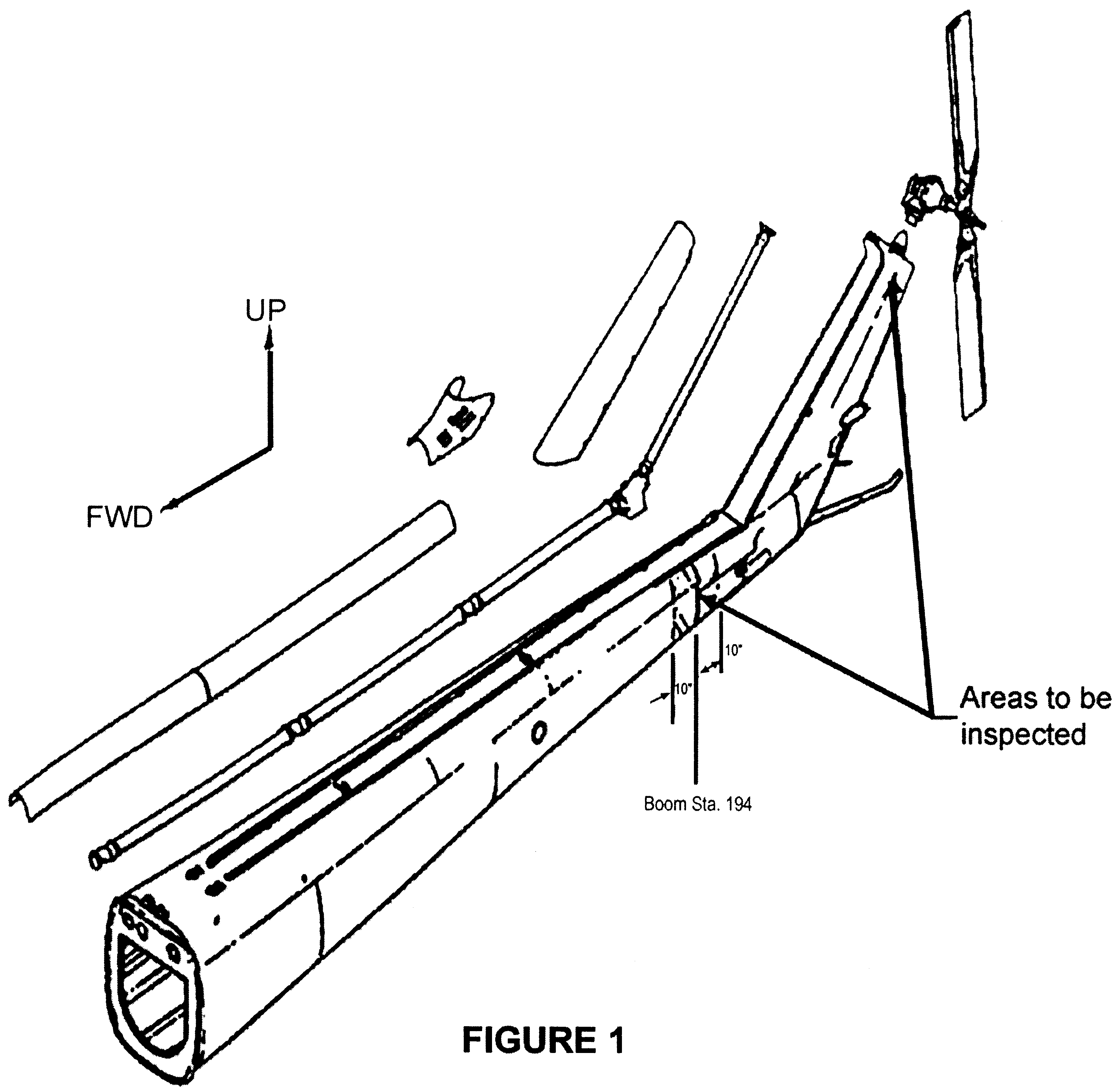
(1) Visually inspect the tailboom assembly skin joint at Boom Station (BS) 194 for fretting, corrosion, loose or working rivets, or a crack. Inspect 10 inches forward and 10 inches aft of BS 194 (BS 194 skin joint area) as shown in the following Figure 1:
( printed page 8864)
Note 2:
The tailboom skin joint at BS 194 is located at the bulkhead just forward of the attachment area for the 42-degree tail rotor gearbox assembly (42-degree gearbox) and the intersection between the vertical fin forward canted bulkhead and the lower tailboom skin.
(2) Visually inspect the vertical fin forward spar caps (2) for a crack at the intersection with the tail rotor gearbox support fitting. Refer to Figure 1 of this AD.
(b) Before further flight, and thereafter at intervals not to exceed 500 hours TIS, radiographically inspect the BS 194 skin joint area in accordance with the requirements of ASTM E 1742-00, MIL-STD-453C, or another FAA-accepted equivalent, for any tailboom assembly with:
(1) Any fretting, corrosion, loose or working rivets, or a crack in the BS 194 skin joint area; or
(2) 1,000 or more hours TIS.
(c) If a crack is found in any part, replace it with an airworthy part before further flight. Repair any corrosion or other damage that exceeds the limitations in the maintenance or overhaul manuals before further flight.
(d) An alternative method of compliance or adjustment of the compliance time that provides an acceptable level of safety may be used if approved by the Manager, Rotorcraft Certification Office, Rotorcraft Directorate, FAA. Operators shall submit their requests through an FAA Principal Maintenance Inspector, who may concur or comment and then send it to the Manager, Rotorcraft Certification Office.
Note 3:
Information concerning the existence of approved alternative methods of compliance with this AD, if any, may be obtained from the Rotorcraft Certification Office.
(e) Special flight permits may be issued in accordance with 14 CFR 21.197 and 21.199 to operate the helicopter to a location where the requirements of this AD can be accomplished.