This site displays a prototype of a “Web 2.0” version of the daily
Federal Register. It is not an official legal edition of the Federal
Register, and does not replace the official print version or the official
electronic version on GPO’s govinfo.gov.
The documents posted on this site are XML renditions of published Federal
Register documents. Each document posted on the site includes a link to the
corresponding official PDF file on govinfo.gov. This prototype edition of the
daily Federal Register on FederalRegister.gov will remain an unofficial
informational resource until the Administrative Committee of the Federal
Register (ACFR) issues a regulation granting it official legal status.
For complete information about, and access to, our official publications
and services, go to
About the Federal Register
on NARA's archives.gov.
The OFR/GPO partnership is committed to presenting accurate and reliable
regulatory information on FederalRegister.gov with the objective of
establishing the XML-based Federal Register as an ACFR-sanctioned
publication in the future. While every effort has been made to ensure that
the material on FederalRegister.gov is accurately displayed, consistent with
the official SGML-based PDF version on govinfo.gov, those relying on it for
legal research should verify their results against an official edition of
the Federal Register. Until the ACFR grants it official status, the XML
rendition of the daily Federal Register on FederalRegister.gov does not
provide legal notice to the public or judicial notice to the courts.
Notice
Enter a search term or FR citation e.g.
88 FR 38230 FR 78782024-13208USDA09/05/24RULE0503-AA39SORN
Choosing an item from
full text search results
will bring you to those results. Pressing enter in the search box
will also bring you to search results.
Choosing an item from
suggestions
will bring you directly to the content.
Request for Comments Concerning Proposed Modification of Action Pursuant to Section 301: China's Acts, Policies, and Practices Related to Technology Transfer, Intellectual Property, and Innovation
September 20, 2019: To be assured of consideration, submit written comments by September 20, 2019.
Table of Contents
Enhanced Content - Table of Contents
This table of contents is a navigational tool, processed from the
headings within the legal text of Federal Register documents.
This repetition of headings to form internal navigation links
has no substantive legal effect.
Comments are no longer being accepted.
See DATES for details.
1 comment has
been received at Regulations.gov.
Agencies review all submissions and may choose to redact, or withhold,
certain submissions (or portions thereof). Submitted comments may not be
available to be read until the agency has approved them.
Document page views are updated periodically throughout the day and are
cumulative counts for this document. Counts are subject to sampling,
reprocessing and revision (up or down) throughout the day.
Page views
7,425
as of
10/10/2026 at 4:15 pm EDT
Other Formats
Enhanced Content - Other Formats
This document is also available in the following formats:
This PDF is FR Doc. 2019-18946 as it appeared on Public Inspection on
08/29/2019 at 8:45 am.
If you are using public inspection listings for legal research, you
should verify the contents of the documents against a final, official
edition of the Federal Register. Only official editions of the
Federal Register provide legal notice of publication to the public and judicial notice
to the courts under 44 U.S.C. 1503 & 1507.
Learn more here.
Published Document: 2019-18946 (84 FR 46212)
This document has been published in the Federal Register. Use the PDF linked in the document sidebar for the official electronic format.
AGENCY:
Office of the United States Trade Representative.
ACTION:
Request for comments.
SUMMARY:
In accordance with the specific direction of the President, the U.S. Trade Representative proposes to modify the action being taken in this investigation by increasing the rate of additional duty from 25 percent to 30 percent on the products of China currently subject to tariff actions first taken in June, August, and September 2018, with an aggregate annual trade value of approximately $250 billion. The products subject to this proposed modification are specified in prior notices, and for the convenience of the public also are set out in the Annexes to this notice. The Office of the U.S. Trade Representative invites public comment on the proposed modification.
DATES:
September 20, 2019:
To be assured of consideration, submit written comments by September 20, 2019.
October 1, 2019:
The proposed modification would be effective on October 1, 2019.
ADDRESSES:
Submit public comments and the public version of comments containing business confidential information (BCI) through the Federal eRulemaking Portal:
http://www.regulations.gov.
The docket number is USTR-2019-0015. Follow the instructions for submitting comments in sections D below. Email comments containing BCI to
301bcisubmissions@ustr.eop.gov.
FOR FURTHER INFORMATION CONTACT:
For questions about this proposed action, contact Associate General Counsel Arthur Tsao or Assistant General Counsel Megan Grimball, or Director of Industrial Goods Justin Hoffmann at (202) 395-5725. For questions on customs classification or implementation of additional duties on products identified in the Annexes to this notice, contact
traderemedy@cbp.dhs.gov.
SUPPLEMENTARY INFORMATION:
A. Prior Determinations in the Investigation
On August 18, 2017, the U.S. Trade Representative initiated an investigation into certain acts, policies, and practices of the Government of China related to technology transfer, intellectual property, and innovation. 82 FR 40213 (August 23, 2017). In April 2018, the U.S. Trade Representative published a notice of a determination that the acts, policies, and practices of China under investigation are unreasonable or discriminatory and burden or restrict U.S. commerce, and are thus actionable under Section 301(b) of the Trade Act of 1974, as amended (Trade Act). 83 FR 14906 (April 6, 2018).
Up through early May 2019, the U.S. Trade Representative, at the direction of the President, determined to take actions resulting in the imposition of an additional 25 percent
ad valorem
duty on products of China with an aggregate annual trade value of approximately $250 billion in order to obtain the elimination of China's acts, policies, and practices covered in the investigation. As explained in prior notices, the actions do not relate to China's acts, policies, and practices involving technology licensing, which are being addressed separately in a WTO dispute settlement proceeding.
The U.S. Trade Representative imposed these additional duties in three tranches. Tranche 1 covered 818 tariff subheadings, with an approximate annual trade value of $34 billion.
See83 FR 28710 (June 20, 2018). Tranche 2 covered 279 tariff subheadings, with an approximate annual trade value of $16 billion.
See83 FR 40823 (August 16, 2018). Tranche 3 covered 5,733 tariff subheadings, with an approximate annual trade value of $200 billion.
See83 FR 47974 (September 21, 2018); 83 FR 49153 (September 28, 2018); and 84 FR 20459 (May 9, 2019).
As described below, the current notice proposes to increase the rate of additional duty on these three tranches from 25 percent to 30 percent, effective October 1, 2019.
In August 2019, the U.S. Trade Representative, at the direction of the President, determined to modify the action being taken in the investigation by imposing an additional 10 percent
ad valorem
duty on products of China with an annual aggregate trade value of approximately $300 billion. 84 FR 43304 (August 20, 2019). Subsequently, at the direction of the President, the U.S. Trade Representative determined to increase the rate of the additional duty applicable to the tariff subheadings covered by the $300 billion action from 10 percent to 15 percent.
B. Proposed Modification of Action
The Section 301 statute (set out in Sections 301 to 308 of the Trade Act) (19 U.S.C. 2411-2418) includes authority for the U.S. Trade Representative to modify the action being taken in an investigation. In particular, Section 307(a)(1) authorizes the U.S. Trade Representative to modify or terminate any action taken under Section 301, subject to the specific direction, if any, of the President, if the burden or restriction on United States commerce of the acts, policies, and practices that are the subject of the action has increased or decreased, or the action is being taken under Section 301(b) and is no longer appropriate.
The burden or restriction on United States commerce of the acts, policies, and practices that are the subject of the Section 301 action continues to increase. China's unfair acts, policies, and practices include not just its technology transfer and IP policies referenced in the notice of initiation in the investigation, but also China's subsequent defensive actions taken to maintain those unfair acts, policies, and practices as determined in that investigation. China has determined to impose tariffs on a substantial majority of U.S. goods exported to China, with the goal of pressuring the United States to cease its efforts to obtain the elimination of China's unfair policies. China has further taken or threatened to take additional countermeasures, including non-tariff measures, against commerce of the United States. For example, China has taken concrete steps to devalue its currency.
See https://home.treasury.gov/news/press-releases/sm751.
Most recently, shortly following the August 2019 announcement of the $300 billion action, China responded by announcing further tariffs on U.S. goods, starting September 1, 2019. In short, instead of addressing the underlying problems, China has increased tariffs and adopted or threatened additional retaliation to further protect the unreasonable acts, policies, and practices identified in the investigation, resulting in increased harm to the U.S. economy.
The United States is engaging with China with the goal of obtaining the elimination of the acts, policies, and practices covered in the investigation. The leaders of the United States and China met on December 1, 2018, and agreed to hold negotiations on a range of issues, including those covered in this Section 301 investigation.
See https://www.whitehouse.gov/briefings-
( printed page 46213)
statements/statement-press-secretary-regarding-presidents-working-dinner-china.
Since the meeting on December 1, 2018, the United States and China have engaged in additional rounds of negotiation on these issues, including meetings in March, April, May, and July 2019. At certain times in these discussions, China has offered specific commitments that were constructive towards reaching a resolution of this matter. However, China more recently has retreated from these commitments.
These circumstances indicate that the action currently being taken is not effective in obtaining the elimination of the unfair acts, policies, and practices covered in the investigation, and thus that maintaining the current 25 percent rate of additional duty on the products covered by prior tariff actions, with an aggregate trade value of $250 billion, may no longer be appropriate.
For these reasons, and in accordance with the specific direction of the President, the U.S. Trade Representative is proposing to modify the action being taken in this investigation by increasing the rate of additional duty from 25 percent
ad valorem
to 30 percent
ad valorem
on goods of China covered by the three prior tariff actions, with an approximate annual trade value of $250 billion, effective October 1, 2019. The tariff subheadings subject to these three prior actions were specified in the original notices of action.
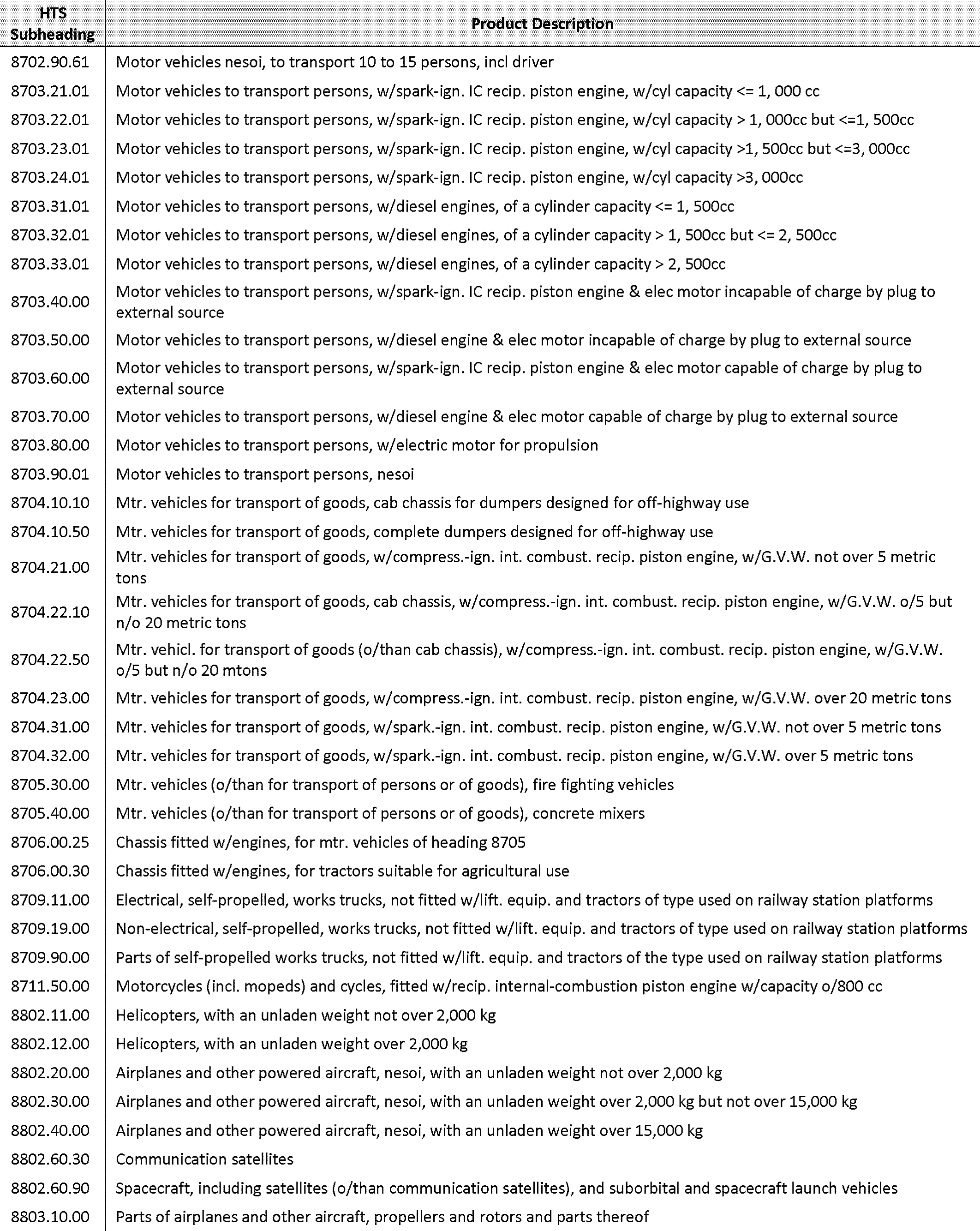
See83 FR 28710 (June 20, 2018), 83 FR 40823 (August 16, 2018), 83 FR 47974 (September 21, 2018), and 83 FR 49153 (September 28, 2018). For the convenience of the public, the three lists of tariff subheadings also are annexed to the current notice. The attached Annexes include conforming changes for any changes in HTSUS subheadings adopted since the original publication date of the original notices of action.
Any increase in the rate of additional duty will not affect exclusions granted under the procedures set out in the USTR exclusion process.
See83 FR 32181 (July 11, 2018); 83 FR 47236 (Sept. 18, 2018); and 84 FR 29576 (June 24, 2019).
C. Requests for Public Comments
USTR invites comments from interested persons with respect to the proposed modification. To be assured of consideration, you must submit written comments by September 20, 2019.
USTR requests that commenters focus specifically on the proposed increase in the rate of additional duty from 25 percent to 30 percent, with an effective date of October 1, 2019. In particular, USTR invites commenters to address specifically whether increasing the rate of additional duties on one or more subheadings listed in the Annexes would be practicable or effective to obtain the elimination of China's acts, policies, and practices, and whether increasing the rate of additional duties on a particular product listed in the Annexes would cause disproportionate economic harm to U.S. interests, including small- or medium-sized businesses and consumers.
D. Procedures for Written Submissions
All submissions must be in English. All public submissions and the public versions of submissions containing BCI must be submitted electronically via
www.regulations.gov.
To submit comments via
www.regulations.gov,
enter docket number USTR-2019-0015 on the home page and click “search.” The site will provide a search-results page listing all documents associated with this docket. Find a reference to this notice and click on the link titled “Comment Now!” For further information on using the
www.regulations.gov
website, please consult the resources provided on the website by clicking on “How to Use Regulations.gov” on the bottom of the home page. We will not accept hand-delivered submissions.
The
www.regulations.gov
website allows users to submit comments by filling in a “Comment” field or by attaching a document using an “Upload File” field. USTR prefers that you submit comments in an attached document. If you attach a document, it is sufficient to type “see attached” in the “Comment” field. USTR prefers submissions in Microsoft Word (.doc) or Adobe Acrobat (.pdf). If you use an application other than those two, please indicate the name of the application in the “Comment” field.
File names should reflect the name of the person or entity submitting the comments. Please do not attach separate cover letters to electronic submissions; rather, include any information that might appear in a cover letter in the comments themselves. Similarly, to the extent possible, please include any exhibits, annexes, or other attachments in the same file as the comment itself, rather than submitting them as separate files.
Do not submit comments containing BCI via
www.regulations.gov.
Instead, interested persons should email any comments containing BCI to
301bcisubmissions@ustr.eop.gov.
The file name of the business confidential version should begin with the characters “BC”. Any page containing BCI must be clearly marked “BUSINESS CONFIDENTIAL” on the top of that page and the submission should clearly indicate, via brackets, highlighting, or other means, the specific information that is business confidential. If you request business confidential treatment, you must certify in writing that disclosure of the information would endanger trade secrets or profitability, and that the information would not customarily be released to the public. Filers of submissions containing business confidential information also must submit a public version of their comments. The file name of the public version—which must be submitted on
www.regulations.gov
—should begin with the character “P”. The “BC” and “P” should be followed by the name of the person or entity submitting the comments or rebuttal comments. If these procedures are not sufficient to protect business confidential information or otherwise protect business interests, please contact the USTR Section Hotline 301 line at (202) 395-5725 to discuss whether alternative arrangements are possible.
USTR will post submissions in the docket for public inspection, except business confidential information. You can view submissions on the
https://www.regulations.gov
website by entering docket number USTR-2019-0015 in the search field on the home page.
Joseph Barloon,
General Counsel, Office of the U.S. Trade Representative.

1 comment has been received at Regulations.gov.
Agencies review all submissions and may choose to redact, or withhold, certain submissions (or portions thereof). Submitted comments may not be available to be read until the agency has approved them.