This site displays a prototype of a “Web 2.0” version of the daily
Federal Register. It is not an official legal edition of the Federal
Register, and does not replace the official print version or the official
electronic version on GPO’s govinfo.gov.
The documents posted on this site are XML renditions of published Federal
Register documents. Each document posted on the site includes a link to the
corresponding official PDF file on govinfo.gov. This prototype edition of the
daily Federal Register on FederalRegister.gov will remain an unofficial
informational resource until the Administrative Committee of the Federal
Register (ACFR) issues a regulation granting it official legal status.
For complete information about, and access to, our official publications
and services, go to
About the Federal Register
on NARA's archives.gov.
The OFR/GPO partnership is committed to presenting accurate and reliable
regulatory information on FederalRegister.gov with the objective of
establishing the XML-based Federal Register as an ACFR-sanctioned
publication in the future. While every effort has been made to ensure that
the material on FederalRegister.gov is accurately displayed, consistent with
the official SGML-based PDF version on govinfo.gov, those relying on it for
legal research should verify their results against an official edition of
the Federal Register. Until the ACFR grants it official status, the XML
rendition of the daily Federal Register on FederalRegister.gov does not
provide legal notice to the public or judicial notice to the courts.
Rule
Enter a search term or FR citation e.g.
88 FR 38230 FR 78782024-13208USDA09/05/24RULE0503-AA39SORN
Choosing an item from
full text search results
will bring you to those results. Pressing enter in the search box
will also bring you to search results.
Choosing an item from
suggestions
will bring you directly to the content.
This table of contents is a navigational tool, processed from the
headings within the legal text of Federal Register documents.
This repetition of headings to form internal navigation links
has no substantive legal effect.
Document page views are updated periodically throughout the day and are
cumulative counts for this document. Counts are subject to sampling,
reprocessing and revision (up or down) throughout the day.
Page views
35
as of
11/11/2026 at 8:15 pm EST
Other Formats
Enhanced Content - Other Formats
This document is also available in the following formats:
This document has been published in the Federal Register. Use the PDF linked in the document sidebar for the official electronic format.
AGENCY:
Federal Aviation Administration, DOT.
ACTION:
Final rule.
SUMMARY:
This amendment adopts a new airworthiness directive (AD), applicable to Robinson Helicopter Company (Robinson) Model R44 helicopters, that requires inspecting the wire harness for contact with the fuel line assembly, removing and replacing the fuel line assembly if chafing has occurred, and installing spiral wrap tubing on the fuel line assembly. This amendment is prompted by four incidents of contact between the wire harness and the fuel line assembly. The actions specified by this AD are intended to prevent contact between the wire harness and the fuel line, which could result in chafing of the wire harness and a potential fire hazard.
EFFECTIVE DATE:
May 11, 2000.
FOR FURTHER INFORMATION CONTACT:
Elizabeth Bumann, Aerospace Engineer, FAA, Los Angeles Aircraft Certification Office, 3960 Paramount Blvd., Lakewood, California 90712-4137, telephone (562) 627-5265; fax (562) 627-5210.
SUPPLEMENTARY INFORMATION:
A proposal to amend part 39 of the Federal Aviation Regulations (14 CFR part 39) to include an AD that is applicable to Robinson Model R44 helicopters was published in the
Federal Register
on August 11, 1999 (64 FR 43638). That action proposed inspecting the wire harness for contact with the fuel line assembly, removing and replacing the fuel line assembly if chafing has occurred, and installing spiral wrap tubing on the fuel line assembly.
Interested persons have been afforded an opportunity to participate in the making of this amendment. Due consideration has been given to the comments received.
The one commenter states that the proposed AD does not mention repair or replacement of the wire harness if chafing damaged the loom. The commenter also states that there are no instructions for ensuring proper clearance between the wire bundle and wrapped fuel pipe. The proposed AD would require inspection of the wire harness for chafing, and maintenance regulations require that the aircraft be restored to an airworthy condition before being returned to service. In order for the aircraft to be in an airworthy condition, a chafed wire harness must be replaced and proper clearance ensured. The FAA has therefore determined that it is not necessary to revise the requirements of the AD in response to these comments. However, for information only, a note 3 has been added to refer the reader to an acceptable method of replacing the wire harness.
After careful review of the available data, including the comments noted above, the FAA has determined that air safety and the public interest require the adoption of the rule with the change described previously. The FAA has determined that this change will neither increase the economic burden on any operator nor increase the scope of the AD.
The FAA estimates that 200 helicopters of U.S. registry will be affected by this AD, that it will take approximately 0.3 work hour per helicopter to accomplish the required actions, and that the average labor rate is $60 per work hour. Required parts will cost approximately $0.22 per helicopter. Based on these figures, the total cost impact of the AD on U.S. operators is estimated to be $3,644.
The regulations adopted herein will not have a substantial direct effect on the States, on the relationship between the national Government and the States, or on the distribution of power and responsibilities among the various levels of government. Therefore, it is determined that this final rule does not have federalism implications under Executive Order 13132.
For the reasons discussed above, I certify that this action (1) is not a “significant regulatory action” under Executive Order 12866; (2) is not a “significant rule” under DOT Regulatory Policies and Procedures (44 FR 11034, February 26, 1979); and (3) will not have a significant economic impact, positive or negative, on a substantial number of small entities under the criteria of the Regulatory Flexibility Act. A final evaluation has been prepared for this action and it is contained in the Rules Docket. A copy of it may be obtained from the Rules Docket at the location provided under the caption
ADDRESSES
.
Accordingly, pursuant to the authority delegated to me by the Administrator, the Federal Aviation Administration amends part 39 of the Federal Aviation Regulations (14 CFR part 39) as follows:
PART 39—AIRWORTHINESS DIRECTIVES
1. The authority citation for part 39 continues to read as follows:
2. Section 39.13 is amended by adding a new airworthiness directive to read as follows:
AD 2000-07-03 Robinson Helicopter Company:
Amendment 39-11657. Docket No. 99-SW-08-AD.
Applicability:
Model R44 helicopters, serial numbers 0002 through 0462, certificated in any category.
Note 1:
This AD applies to each helicopter identified in the preceding applicability provision, regardless of whether it has been otherwise modified, altered, or repaired in the area subject to the requirements of this AD. For helicopters that have been modified, altered, or repaired so that the performance of the requirements of this AD is affected, the owner/operator must request approval for an alternative method of compliance in accordance with paragraph (e) of this AD. The request should include an assessment of
( printed page 17988)
the effect of the modification, alteration, or repair on the unsafe condition addressed by this AD; and if the unsafe condition has not been eliminated, the request should include specific proposed actions to address it.
Compliance:
Required within 100 hours time-in-service or 90 calendar days after the effective date of this AD, whichever occurs first, unless accomplished previously.
To prevent contact between the wire harness and the fuel line assembly, which could result in chafing of the wire harness and a potential fire hazard, accomplish the following:
(a) Remove the cover, part number (P/N) C474-1, from between the rear seatbacks.
(b) Inspect the wire harness, P/N C059, and the fuel line assembly, P/N C726-2, above the fuel shutoff valve for contact. If the wire harness contacts the fuel line assembly, inspect for chafing.
(c) If chafing has occurred between the wire harness and the fuel line assembly, replace the fuel line with an airworthy fuel line assembly. Torque the fuel line nuts to 110-130 in-lbs. Verify that clearance exists between the fuel line assembly and the wire harness.
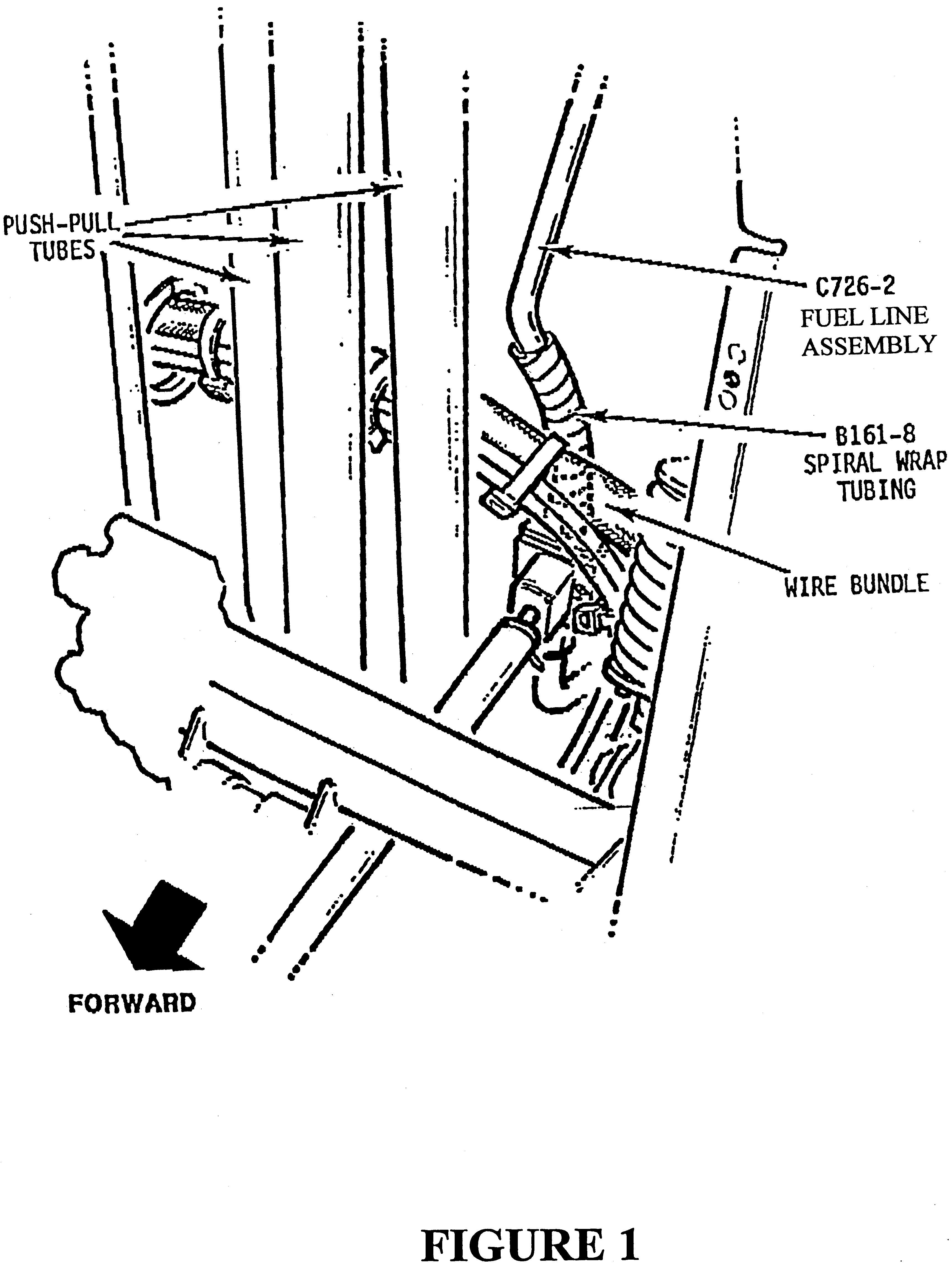
(d) Install a 3-inch section of spiral wrap tubing, P/N B161-8, on the fuel line assembly as shown in Figure 1. Push the spiral wrap tubing down until it is against the fuel line fitting.
Note 2:
Robinson Helicopter Company Service Bulletin SB-31, dated October 28, 1998, pertains to the subject of this AD.
Note 3:
Advisory Circular 43.13-1B, Chapter 11, describes procedures acceptable for replacing the wire harness if required.
( printed page 17989)
( printed page 17990)
(e) An alternative method of compliance or adjustment of the compliance time that provides an acceptable level of safety may be used if approved by the Manager, Los Angeles Aircraft Certification Office. Operators shall submit their requests through an FAA Principal Maintenance Inspector, who may concur or comment and then send it to the Manager, Los Angeles Aircraft Certification Office.
Note 4:
Information concerning the existence of approved alternative methods of compliance with this AD, if any, may be obtained from the Los Angeles Aircraft Certification Office.
(f) Special flight permits may be issued in accordance with sections 21.197 and 21.199 of the Federal Aviation Regulations (14 CFR 21.197 and 21.199) to operate the helicopter to a location where the requirements of this AD can be accomplished.
(g) This amendment becomes effective on May 11, 2000.