This site displays a prototype of a “Web 2.0” version of the daily
Federal Register. It is not an official legal edition of the Federal
Register, and does not replace the official print version or the official
electronic version on GPO’s govinfo.gov.
The documents posted on this site are XML renditions of published Federal
Register documents. Each document posted on the site includes a link to the
corresponding official PDF file on govinfo.gov. This prototype edition of the
daily Federal Register on FederalRegister.gov will remain an unofficial
informational resource until the Administrative Committee of the Federal
Register (ACFR) issues a regulation granting it official legal status.
For complete information about, and access to, our official publications
and services, go to
About the Federal Register
on NARA's archives.gov.
The OFR/GPO partnership is committed to presenting accurate and reliable
regulatory information on FederalRegister.gov with the objective of
establishing the XML-based Federal Register as an ACFR-sanctioned
publication in the future. While every effort has been made to ensure that
the material on FederalRegister.gov is accurately displayed, consistent with
the official SGML-based PDF version on govinfo.gov, those relying on it for
legal research should verify their results against an official edition of
the Federal Register. Until the ACFR grants it official status, the XML
rendition of the daily Federal Register on FederalRegister.gov does not
provide legal notice to the public or judicial notice to the courts.
Rule
Enter a search term or FR citation e.g.
88 FR 38230 FR 78782024-13208USDA09/05/24RULE0503-AA39SORN
Choosing an item from
full text search results
will bring you to those results. Pressing enter in the search box
will also bring you to search results.
Choosing an item from
suggestions
will bring you directly to the content.
This table of contents is a navigational tool, processed from the
headings within the legal text of Federal Register documents.
This repetition of headings to form internal navigation links
has no substantive legal effect.
Document page views are updated periodically throughout the day and are
cumulative counts for this document. Counts are subject to sampling,
reprocessing and revision (up or down) throughout the day.
Page views
60
as of
10/07/2026 at 2:15 am EDT
Other Formats
Enhanced Content - Other Formats
This document is also available in the following formats:
This document has been published in the Federal Register. Use the PDF linked in the document sidebar for the official electronic format.
AGENCY:
National Environmental Satellite, Data, and Information Service (NESDIS), National Oceanic and Atmospheric Administration (NOAA), Department of Commerce.
ACTION:
Final rule.
SUMMARY:
This final rule amends the regulations setting forth policies and procedures regarding space-based data collection systems (DCS) to allow expanded use of the NOAA DCS for government interests and to permit greater flexibility in utilizing these vital U.S. data collection assets in support of homeland security, National security, law enforcement, and humanitarian operations.
DATES:
Effective September 2, 2003.
ADDRESSES:
Copies of supporting documents may be obtained from Kay Metcalf, NOAA, NESDIS, Direct Services Division, E/SP3, Room 3320, FB-4, 5200 Auth Road, Suitland, Maryland 20746-4304.
NOAA enacted 15 CFR part 911, effective June 5, 1998, to revise its policies and procedures for authorizing the use of the space-based DCS that operate on NOAA's Geostationary Operational Environmental Satellites (GOES) and on its Polar-orbiting Operational Environmental Satellites (POES). For general background on NOAA DCS, refer to the notice of final rulemaking published in the
Federal Register
on May 6, 1998, at 63 FR 24917.
The background and rationale for the revisions to the DCS regulations were provided in the preamble to the proposed rule published in the
Federal Register
on April 8, 2003, at 68 FR 16993, and are not repeated here.
NOAA received no comments on the proposed rule and, therefore, is adopting the proposed rule as a final rule without change.
The Chief Counsel for Regulation of the Department of Commerce certified to the Chief Counsel for Advocacy of the Small Business Administration that this rule will not have a significant economic impact on a substantial number of small entities as that term is defined in the Regulatory Flexibility Act, 5 U.S.C. 601et seq.
The factual basis for this certification was published in the proposed rule and is not repeated here. No comments were received regarding the economic impact of this rule. As a result, no final regulatory flexibility analysis was prepared.
Paperwork Reduction Act of 1995 (35 U.S.C. 3500 et seq.)
This rule contains collection-of-information requirements subject to the Paperwork Reduction Act (PRA) and which have been approved by OMB under control number 0648-0157. Public reporting burden for these requirements is estimated to average 3 hours per GOES agreement and 1 hour per Argos agreement, including the time for reviewing instructions, searching
( printed page 45161)
existing data sources, gathering and maintaining the data needed, and completing and reviewing the collection of information. Send comments regarding this burden estimate, or any other aspect of this data collection, including suggestions for reducing the burden, to NESDIS (
seeADDRESSES
) and to OMB at the Office of Information and Regulatory Affairs, Office of Management and Budget, Washington, DC 20503 (Attention: NOAA Desk Officer).
Notwithstanding any other provision of the law, no person is required to respond to, nor shall any person be subject to a penalty for failure to comply with, a collection of information subject to the requirements of the PRA, unless that collection of information displays a currently valid OMB Control Number.
National Environmental Policy Act (42 U.S.C. 4321 et seq.)
Publication of the final regulations does not constitute a major Federal action significantly affecting the quality of the human environment. Therefore, an environmental impact statement is not required.
(p)
Sensitive use
means the use of the NOAA DCS where the users' requirements dictate the use of a governmental system such as National security, homeland security, law enforcement and humanitarian operations.
(q)
Testing use
means the use of the NOAA DCS by manufacturers of platforms for use in conjunction with the NOAA DCS, for the limited purpose of testing and certifying the compatibility of new platforms with the technical requirements of the NOAA DCS.
(r)
User
means the entity and/or organization that owns or operates user platforms for the purpose of collecting and transmitting data through the NOAA DCS, or the organization requiring the collection of the data.
(s)
User platform
means device designed in accordance with the specifications delineated and approved by the Approving Authority used for the in-situ collection and subsequent transmission of data via the NOAA DCS. Those devices which are used in conjunction with the GOES DCS are referred to as data collection platforms (DCP) and those which are used in conjunction with the Argos DCS are referred to as Platform Transmitter Terminals (PTT). For purposes of these regulations, the terms “user platform,” “DCP”, and “PTT” are interchangeable.
(t)
User requirement
means the requirement expressed and explained in the System Use Agreement.
3. Section 911.4 is amended by revising paragraphs (c)(3) and (c)(4) to read as follows:
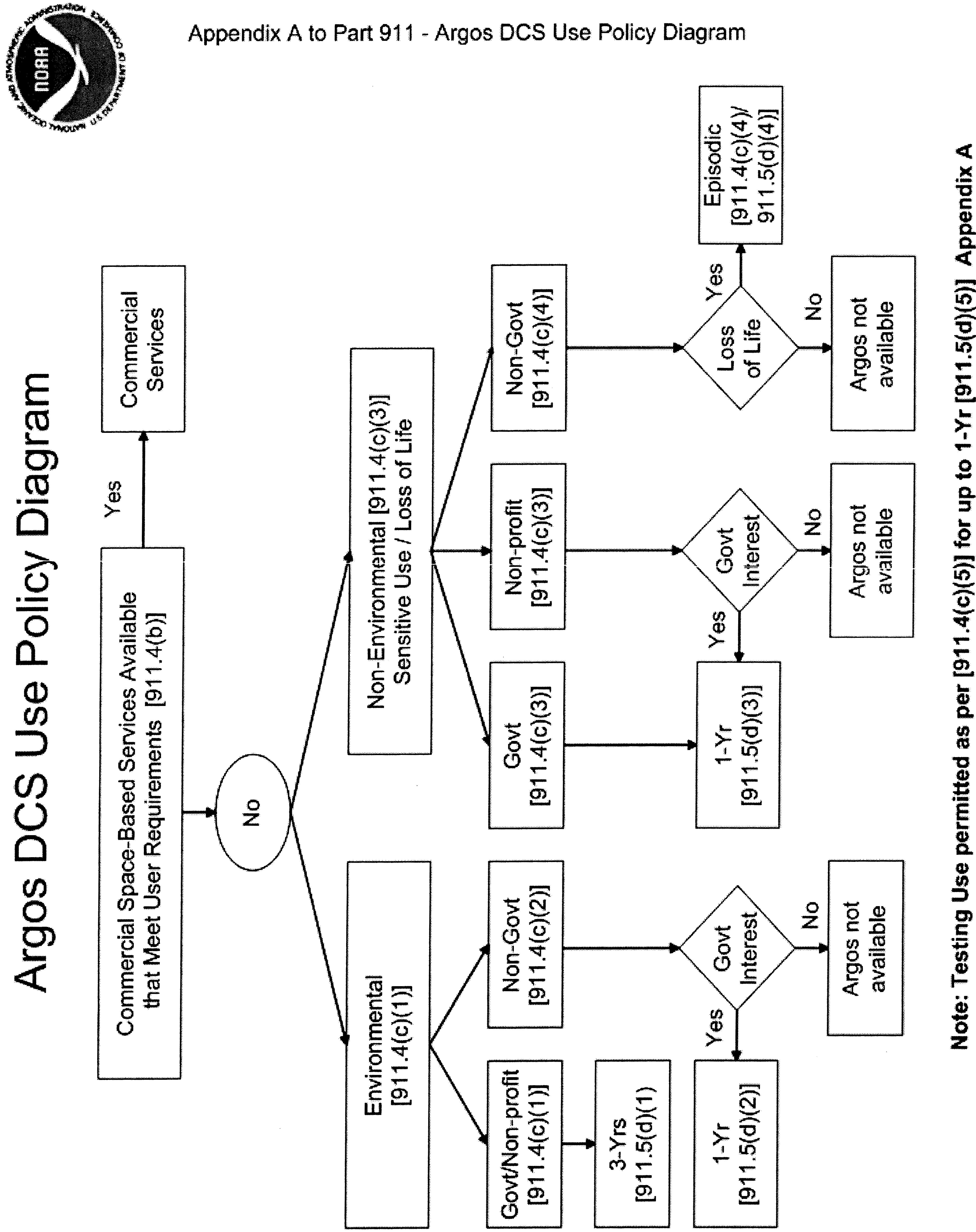
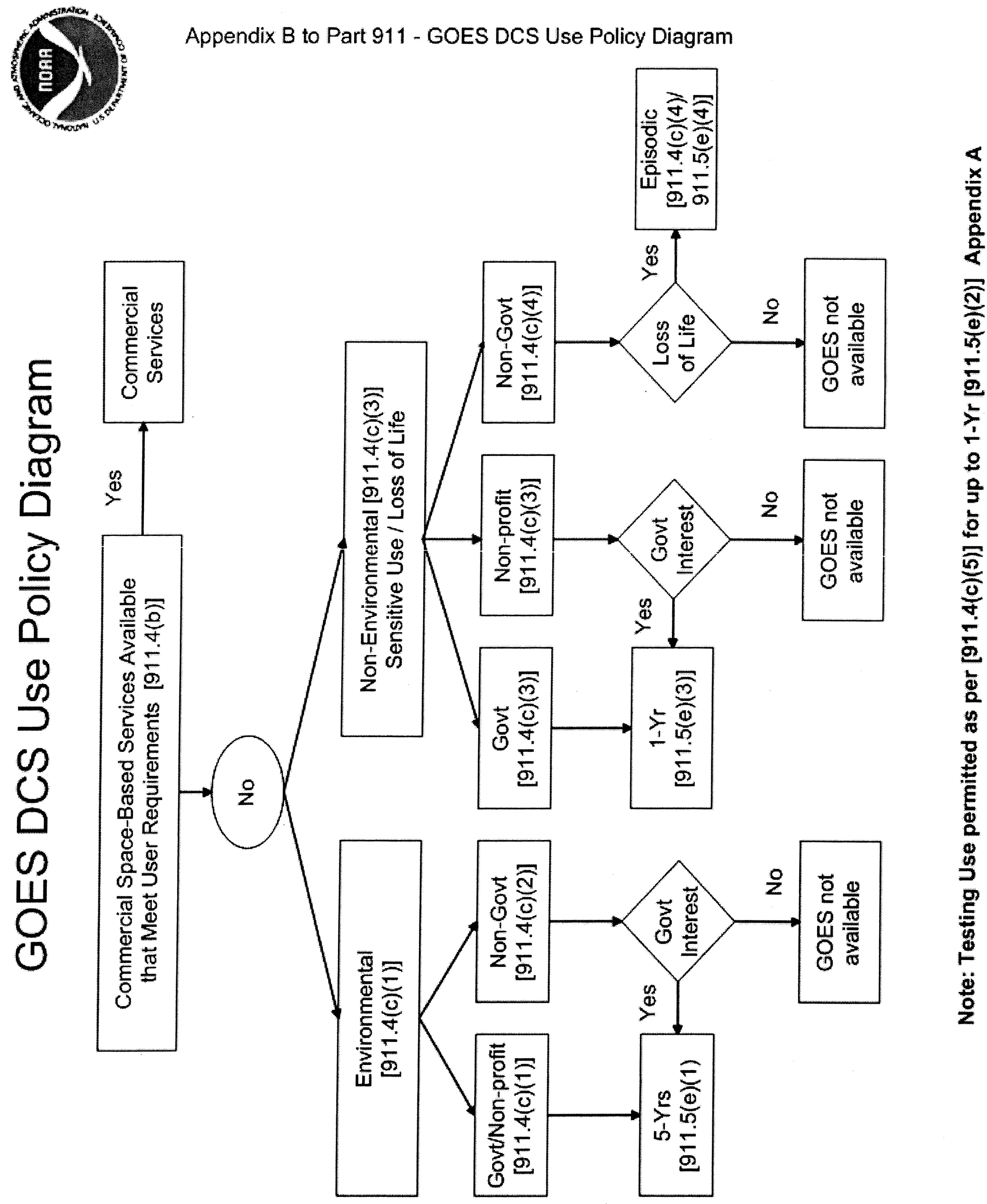
(3) Except as provided in paragraph (c)(4) of this section, non-environmental use of the NOAA DCS is only authorized for government use and non-profit users where there is a government interest. The NOAA DCS will continue to be predominantly used for environmental applications. Non-environmental use of the system shall be limited to sensitive use, and to episodic use as defined below in paragraph (c)(4) of this section.
(4) Episodic use of the NOAA DCS may also be authorized in specific instances where there is a significant possibility for loss of life. Such use shall be closely monitored.
* * * * *
4. Section 911.5 is amended by revising paragraphs (c) and (e)(1), and adding new paragraphs (e)(3) and (e)(4) to read as follows:
(c) The Director shall evaluate user requests for System Use Agreements and renewals and conclude agreements for use of the NOAA DCS.
* * * * *
(e) * * *
(1) Agreements for the collection of environmental data, by the GOES DCS, shall be valid for 5 years from the date of initial in-situ deployment, and may be renewed for additional 5-year periods.
* * * * *
(3) Agreements for the collection of non-environmental data, via the GOES DCS, by government agencies, or non-profit institutions where there is a government interest, shall be valid for 1 year from the date of initial
in-situ
deployment of the platforms, and may be renewed for additional 1-year periods.
(4) Agreements for the episodic collection of non-environmental data, via the GOES DCS under § 911.4(c)(4), shall be of short, finite duration not to exceed 1 year without exception, and usually shall not exceed 6 months. These agreements shall be closely monitored and shall not be renewed.
(a) All NOAA DCS users must agree to permit NOAA and other agencies of the U.S. Government the full, open, timely, and appropriate use as determined by NOAA, of all environmental data collected from their platforms; this may include the international distribution of environmental data under the auspices of the World Meteorological Organization.
(b) Raw data from the NOAA space segment is openly transmitted and accessible.
(c) Accessibility of the NOAA DCS processed data from the ground segment is handled in accordance with the users specifications and system design limitations, subject to the provisions stated in paragraph (a) of this section.